FAQ
Oscilloscopes
DS-5300/5400/5400A/5500/5500A/5600/5600ASeries
- Are the channels isolated?
-
No.
- Can I use any USB memory device?
-
The device can recognize those formatted in FAT or FAT32. NTFS format is not recognized. However, if the capacity is large, it will take time to recognize, so we recommend that you use a USB memory device of less than 8GB.
- I want to see the waveform (binary) files saved in the USB memory device on my PC.
-
When you install Iwatsu Test Instruments Tools from the download page, IWATSU Scope Viewer is installed and you can view waveform (binary) files with this software.
- I cannot select the print destination for the printer in the print menu.
-
Press the UTILITIES key → “Remote” → Turn “Interface” OFF.
- On the replay screen, I want to show the time it took to trigger.
-
Press the UTILITIES key → System settings → Date and time → Display to the Trigger time (for DS-5300) and the Waveform acquisition time (for DS-5500), and then import the waveform.
- I want to use the virtual COM port remotely, but please tell me the communication settings on the application software side.
-
Baud rate:19200
Bit length:8
Stop bit length:1
Parity Yes/No:None
Hardware handshake Yes/No:None - Where is the USB driver?
-
The USB driver is also installed by installing the Iwatsu Test Instruments Tools from the download page.
- Please tell me the remote command of the automatic measurement item Skew @ Level.
-
With the MSEL command, select the automatic measurement item DELTA. Use the TPRM command to set the measurement conditions.
Digital Multimeters
VOAC7523 /7522 /7520 /7521A /7523H /7522H /7520H /7521H
- I set the communication condition, but remote operation does not function.
-
Check that the Remote I/F in the system settings is set to None. If it is set to None, select the interface that you want to use.
- The indication disappears after a while.
-
The device is in power saving mode. To cancel the power saving mode, set the system setting LOW-POWER to OFF. You can set the time until the indication disappears between 10 minutes and 60 minutes in 10-minute increments in the system menu.
- The temperature measurement error is large immediately after thermocouple mounting.
-
Make sure that the terminals and ventilation holes are not exposed to wind, and warm up for at least one hour until the temperature of the equipment stabilizes.。
- I want the AC voltage to be displayed as a peak value.
-
In the case of a sine wave, the scaling operation (X-A) × B/C is displayed as A = 0, B = 2.82, C = 1.
- I want to hold the peak value.
-
With statistical operation (MAX/MIN), when the device is set to continuous (CONT) mode, peak hold of the maximum and minimum values can be performed.
- Please tell me how to zero the resistance measurement.
-
Short the test lead and press the REL button. When the display reaches 0 with the LED of the REL button lit, measurement can be started.
- How do I read accuracy 0.025+10?
-
0.025% of reading + minimum resolution x10 count
- What is the trigger input circuit for the digital I/O module SC-352?
-
Pulled up to +5V with 10kΩ resistance, connected to buffer IC input.
- Are CH-A and CH-B isolated?
-
Yes. There is an input impedance between CH-B: H and CH-A: L, CH-B: L and CH-A: L of 5MΩ.
- I am measuring the resistance of a coil, but the value is wrong.
-
Oscillation may occur if the measured circuit has a capacitance component. Check whether the circuit is oscillating with an oscilloscope. If a capacitor of the appropriate capacitance is inserted in parallel to the input, the resonance point will be shifted and the oscillation will stop, so it may be possible to measure normally.
- What is the integration time?
-
For SLOW, MID, 20ms in the 50Hz area, 16.6ms in the 60Hz area.
- Can the DC voltage measurement (DCV) function measure the average pulse voltage?
-
No, because the DCV function is designed for measuring DC voltages.
Universal Counter
SC-7217A / SC-7217/ SC-7215A / SC-7215
- Where is the USB driver?
-
It is installed with Iwatsu Test Instruments Tools from the website downloads.
(Compatible models: SC-7217/SC-7215) - What is the frequency count method?
-
Reciprocal counting.
(Compatible models: SC-7217/SC-7215) - I cannot measure 1Hz at the 10 second gate.
-
Set the GATE_CLOSE of the measurement [MEASURE] ([2nd + TRIGLVL]) menu to WAIT.
(Compatible models:SC-7217A / SC-7217/ SC-7215A / SC-7215) - When I use remote, the device is placed on hold.
-
You can release the hold mode by sending the FRUN ON command.
(Compatible models:SC-7217 / SC-7215) - There is no key to measure peak voltage.
-
Use the MEASURE menu to set it.
Press [2nd], [TRIG LVL], and in the menu, VPP: Set the channel that you want to measure to ON. Press the [MODE] key to peak.
(Compatible models:SC-7217 / SC-7215) - * Items that are initialized by the RST command
-
Use the MEASURE menu to set it.
The items in the table “Target of save/call” in the user manual “3.3 Backup of settings” that are shown as ○
(Compatible models:SC-7217 / SC-7215)
SC-720xH Series, SC-720x Series common
- What is the reference oscillator accuracy?
-
± 2.5ppm.
(Standard for temperature characteristics in the range of 0 to +40°C)
(Compatible models: SC-720xH Series, SC-720x Series common) - What is 1 reference time for measurement error?
-
It is 0.1μs, which is the cycle of the reference oscillator 10MHz.
(Compatible models: SC-720xH Series, SC-720x Series common) - Is there an optional 10:1 probe for counters?
-
Unlike the oscilloscope, there is no dedicated probe because the phase cannot be adjusted by looking at the screen. If the measured signal is a sinusoidal waveform, a 10:1 probe for the oscilloscope can be used.
(Compatible models: SC-720xH Series, SC-720x Series common) - No Signal sometimes displays.
-
No Signal is displayed if the signal disappears before the gate opens. When the gate is open, the count remains when the signal disappears.
(Compatible models: SC-720xH Series, SC-720x Series common) - Can I change the power supply voltage?
-
Yes, but it is a factory pick-up option.
(Compatible models: SC-720xH Series, SC-720x Series common) - When I use remote, the device is placed in hold mode.
-
The device is designed to enter hold mode in remote.
The SC-720xH Series can be released from hold mode by sending the :FRUN ON command.
(Compatible models: SC-720xH Series, SC-720x Series common) - There is no key to measure peak voltage.
-
The peak voltage can be measured by the following operations. Press the “STAT” key and the “>>” key to set Vpp A = on B = on, and then press the “MODE” key several times to switch the display.
(Compatible models: SC-720xH Series, SC-720x Series common)
SC-7207H / 7205H / 7207 / 7205
- Can CH-B measure frequency?
-
It is possible with SC-7207H and SC-7205H. It is not possible with the SC-7207 or SC7205 models.
(Compatible models:SC-7207H / SC-7205H / SC-7207 / SC-7205) - I want to measure the time interval of a single signal.
-
Use the pulse width measurement function to measure the time interval from rise to fall or from fall to rise.
If you want to measure the time from rise to rise or from fall to fall, branch the signal and enter CH-A and CH-B. In this case, the stop-inhibit function can be used in conjunction to avoid unwanted problems.
(Compatible models:SC-7207H / SC-7205H / SC-7207 / SC-7205) - In the time interval measurement, when I send the *TRG command using GPIB remote when the gate is open and the measurement is not completed, hang up occurs.
-
For SC-7207H/7206H/7205H, set the GATE_CLOSE setting of the SYSTEM menu to FAST. When the set internal gate time has passed about 1 second, if the measurement has not been completed, it is forced to terminate.
For SC-7207/7206/7205, perform GPIB device clear.
We recommend that you incorporate timeout error processing on the application software side.(Compatible models:SC-7207H / SC-7205H / SC-7207 / SC-7205)
- The same signal is input to CH-A and CH-B, but the phase difference is not measured at 0°.
-
Phase difference 0° cannot be measured. A time difference of at least 6ns is required.
(Compatible models:SC-7207H / SC-7205H / SC-7207 / SC-7205) - I want to perform pendulum operation only once by time interval measurement.
-
Measure in hold mode. Press the “HOLD” key to illuminate the lamp, and press it again to activate the pendulum.
(Compatible models:SC-7207H / SC-7205H / SC-7207 / SC-7205)
B-H Analyzer
Introductory Edition Question
- What is the difference between a B-H analyzer and a DC curve tracer?
-
The measurement principle is the same. The difference is the excitation method. The DC curve tracer excites the sample by changing the output of the DC power supply into a sinusoidal waveform or a triangular waveform very gently over several tens of seconds, and obtains a B-H waveform for one cycle. On the other hand, the B-H analyzer generates a sine wave or a square wave of a set frequency instead of DC from the built-in signal generator, amplifies it with an AC power amplifier, excites the sample, and obtains a B-H waveform for one cycle. The DC curve tracer is suitable for measuring the static characteristics of the magnetic properties of the sample.
On the other hand, the B-H analyzer is suitable for measuring high-frequency characteristics, which are dynamic characteristics of magnetic properties. - What is the difference between a B-H analyzer and an impedance analyzer?
-
An impedance analyzer is a parameter measuring device for electronic components at small signals (tens of mA), and for magnetic parts, it can measure parameters such as L, Q, R, Z. On the other hand, the B-H analyzer can measure the magnetic properties of soft magnetic objects such as the B-H curve, core loss, and magnetic permeability of magnetic parts from small signals to large signals (5mA to 6A). The B-H analyzer is suitable for measuring magnetic parts under actual driving conditions.
- Some oscilloscopes can also measure magnetic properties such as core loss, but what is the difference with the B-H analyzer?
-
he function of determining the magnetic field (strength), magnetic flux density, and other magnetic characteristic values from the measured excitation current and induced voltage is the same, but measurement using an oscilloscope and measurement using a B-H analyzer differ greatly in the following two points.
- Measurement resolution of excitation current and induced voltage
- Phase difference correction method between excitation current and induced voltage
First of all, in terms of the measurement resolution ①, the measurement resolution of a typical oscilloscope is 8 bits. On the other hand, the B-H analyzer is equipped with 16 bits for SY-8218/SY-8219. The B-H analyzer can capture waveforms with high resolution, so magnetic characteristic values can be obtained with high measurement accuracy.
Next, in terms of phase difference correction ②, the phase difference between the excitation current and the induced voltage is an important parameter that has a great impact on the core loss. In measurement with an oscilloscope, the time difference between the measurement channels is canceled (deskewed) by skew adjustment, and this phase difference correction is performed. However, due to the fact that the frequency-phase characteristics of the current probe are not linear (the group delay characteristics are not flat), precise phase correction cannot be performed by deskew alone. Some power analyzers have a deskew function, but similarly precise phase correction is not possible.
On the other hand, with the B-H analyzer, frequency-phase characteristics between measurement channels are measured in advance, and this phase difference is precisely corrected for each frequency and for each measurement range. Therefore, the B-H analyzer can measure core loss with extremely high measurement accuracy. The B-H analyzer can measure extremely small core losses of pressed powder-based materials that are difficult to measure with an oscilloscope or power analyzer.
- What materials and shapes can be measured with the B-H analyzer?
-
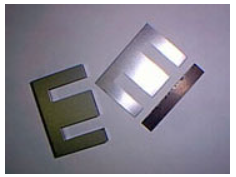
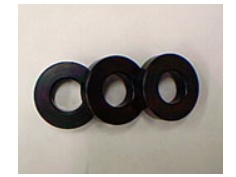
It is possible to measure soft magnetic samples with a windable closed magnetic circuit shape, such as a toroidal, EI, EE core, etc. In addition, by combining with the small single-plate magnetic measurement device SY-956, you can also measure plates and sheet-like samples.
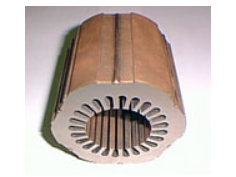
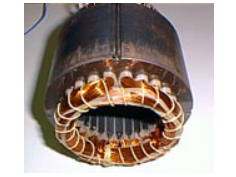
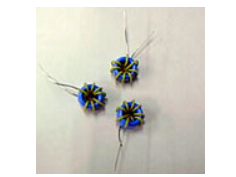
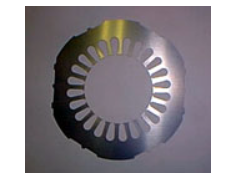
[Reference] Example of measurement sample shape

EI core
Dust core
Motor stator
Motor rotor
Amorphous core
Stator laminate
- Can the B-H analyzer measure magnetic permeability?
-
You can measure it by filling the optional empty toroidal core SY-513 with powder and winding.
- What range of magnetic flux densities can be measured with the B-H analyzer?
-
In the region where the B-H curve is unsaturated due to sine wave excitation, the relationship between the maximum magnetic flux density Bm and the induced voltage V2 is expressed by the following equation.
f: Measurement frequency Ae: Effective cross-sectional area of the sample N2: Number of secondary windings
V2=2πfN2AeBm
Therefore, in the unsaturated region, it is possible to measure up to Bm corresponding to V2 within the detected voltage range of the B-H analyzer used. For SY-8218 and SY-8219, the maximum permissible value of V2 is 200V. Note that this equation does not apply to non-sinusoidal excitation or saturated regions.
- What magnetic field (strength) can be excited by the B-H analyzer?
-
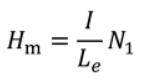
The maximum magnetic field Hm that can be excited is determined by the following equation.
I: Excitation current N1: Number of primary windings Le: Average magnetic path length
The excitation current I depends on the power amplifier used.
- What frequencies can be measured with the B-H analyzer?
-
It depends on the options combined with the B-H analyzer model. The measurement frequencies for each model of the B-H analyzer are shown in the table below. For the measurement frequency based on the combined option, see the explanation of each option.
Model name Measurement frequency SY-8218 10Hz~10MHz SY-8219 10Hz~1MHz The B-H analyzer can measure up to the above frequencies in terms of performance, but it is necessary to pay attention to the inductance L of the sample for the upper limit frequency.
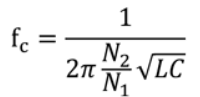
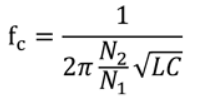
Since the input capacitance C of the B-H analyzer and the inductance L of the sample form an LC parallel resonance circuit, it is necessary to ensure that the measurement frequency is 1/10 or less of the resonance frequency. Please also take this into account when selecting the model. Note that the resonance frequency fc can be calculated from the following equation.
L: Inductance of sample C: Input capacitance of measurement device (SY-8218/SY-8219 is approx. 18.5pF) N1: Number of primary windings N2: Number of secondary windingsThe effect of resonance is greater in samples with even high phase angles (≥ approx. 87°), so when measuring samples with high phase angles, it is recommended to measure at a frequency less than 1/20 of the resonance frequency.
- Can the B-H analyzer measure DC superposition?
-
You can measure by combining SY-8218/SY-8219 with the optional DC bias tester SY-960 (SY-961, SY-962). Since it is not necessary to apply a tertiary winding for DC excitation to the sample, measurements can be made much more easily than in the past.
- Can the B-H analyzer measure pulse excitation?
-
SY-8218/SY-8219 is limited to Duty 50%, but measurements can be made at 10Hz to 1MHz as standard. In addition, measurements can be made at 10kHz to 1MHz with variable Duty 10 to 90% by combining with the optional DC bias tester SY-960 (SY-961, SY-962).
- Can the B-H analyzer measure saturated flux density?
-
If the magnetic field (strength) and induced voltage corresponding to the saturated magnetic flux density are within the measurement range of the B-H analyzer, measurements can be made..
- Can the B-H analyzer measure magnetic permeability?
-
The amplitude specific magnetic permeability and complex magnetic permeability can be measured with the SY-8218/SY-8219. You can also measure the amplitude specific magnetic permeability at any point of the B-H curve by using the curve measurement function.
- Can the B-H analyzer measure temperature characteristics?
-
You can make measurements by combining with the optional thermostatic chamber scanner system. The following table shows the main specifications of the thermostatic chamber scanner system.
Thermostatic chamber scanner system SY-320A SY-321A Compatible models SY-8218 ○ SY-8219 ○ Maximum number of measurement samples 20 pieces 41 pieces Temperature control range -30[℃]~+150[℃] Maximum measurement current ±6[A] Maximum measurement voltage ±200[V] When combined with the thermostatic chamber scanner system, the upper limit for measurement frequency is 5MHz. If the upper limit of measurement frequency of the combined B-H analyzer or power amplifier used is less than this, this limit will be the upper limit of measurement frequency.
[Reference] Thermostatic Chamber Scanner System - Can I measure the change over time in magnetic properties?
-
You can measure it by adding the optional software SY-811 continuous measurement function to the B-H analyzer. The sample can be maintained in an excited state, measured at 1-minute intervals, and the change over time in magnetic properties can be measured for up to 99,999 minutes (approx. 70 days).
- Can the b-h analyzer measure automatic programs?
-
If you incorporate the optional remote control software SY-810 into your PC, you can perform automatic program measurement with the B-H analyzer alone or in combination with optional equipment such as the thermostatic chamber scanner system. For the main specifications of the SY-810, see the following. Since the communication command for the remote control is not published, the customer cannot make a program and independently measure using remote control with the B-H analyzer.
Contents Equipment that allows automatic measurements B-HB-H AnalyzerSY-8218/8219 Thermostatic chamber scanner system SY-320A/321A Compact Single-Plate Magnetic Measurement Device SY-956 DC bias testerSY-960/961/962 Number of measurement condition settings (per sample) 40 (* For SY-320A/321A) Number of temperature condition settings (per sample) 20 (* For SY-320A/321A) Measurement data save format CSV Measurement screen save format JPEG / PNG Supported OS Windows 8.1 / 8 / 7 / Vista - What kind of dedicated power amplifiers are available?
-
We offer a dedicated power amplifier with 4 quadrant output. Select the desired model by referring to the compatibility table below.
- Can I measure without using a dedicated power amplifier?
-
You can measure with a 4-quadrant output power amplifier, even if you do not use the dedicated power amplifier. The dedicated power amplifier is designed to fine-tune the DC offset adjustment to a range of ±1V and to bring the DC offset to zero without limit. If there is a DC offset, the magnetic characteristics of the unintended DC superposition are measured and an asymmetric B-H curve is drawn. If you do not use the dedicated power amplifier, you should pay close attention to this point. If the DC offset cannot be zeroed, the optional SY-514 LF AC coupler can be used to completely zero the DC offset at a measurement frequency of 300Hz or higher.
- Can you provide sample measurements?
-
Yes, for a fee. For further information, please contact us.
Measurement Edition Question
- Why do core loss measurements differ when the number of windings is changed during high-frequency measurements?
-
The first cause of the difference may be the effect of the LC parallel resonance phenomenon. The resonance frequency varies depending on the number of windings. Core loss measurement can be measured if the detected voltage and current are within the measurable range of the B-H analyzer. However, caution is required during high-frequency measurement because the input capacitance C of the B-H analyzer and the inductance L of the sample form an LC parallel resonance circuit. Use the device with a measurement frequency that is less than 1/10 of the resonance frequency. The resonance frequency fc can be calculated from the following equation.
L: Inductance of sample C: Input capacitance of B-H analyzer (SY-8218/SY-8219 is approx. 18.5pF) N1: Number of primary windings N2: Number of secondary windings
The effect of resonance is greater in samples with even high phase angles (≥ approx. 87°), so when measuring samples with high phase angles, it is recommended to measure at a frequency less than 1/20 of the resonance frequency.
The second reason may be the influence of the magnetic field (strength) H inside the sample, or the inhomogeneity of the magnetic flux density B. If the magnetic permeability of the sample is low, the shape is not toroidal, or the winding is not uniform, the size of H, B inside the sample often differs depending on the position of the sample. If the number of windings is changed, the average excitation position of H or the average detection position of B may change, resulting in a difference in core loss.
- If you increase the value of Bm with sine wave excitation, the measured current or voltage waveform will no longer be in the form of a sine wave and will be distorted. What is the reason for this?
-
Waveform distortion occurs due to the sample characteristics. This is because the magnitude of the magnetic flux density B changes non-linearly with respect to the magnetic field (strength) H. The waveform distortion is especially more pronounced when approaching the saturated magnetic flux density of the sample.
- What number of windings are suitable for measurement?
-
The recommended number of windings is as follows:
Excitation coil N1: 3 or more turns
Detection coil N2: N1 ≥ N2 with 1 turn or moreIf N1 is low, a large current is required for the required magnetic field (strength), and if N2 is high, the induced voltage detected increases. In addition, if N1 < N2, the input capacitance of the B-H analyzer from the perspective of the excitation system will be doubled to the square of (N2/N1), and the parallel resonance frequency fc will drop to N1/N2 so caution is required.
- What is the appropriate way to wind the sample coil?
-
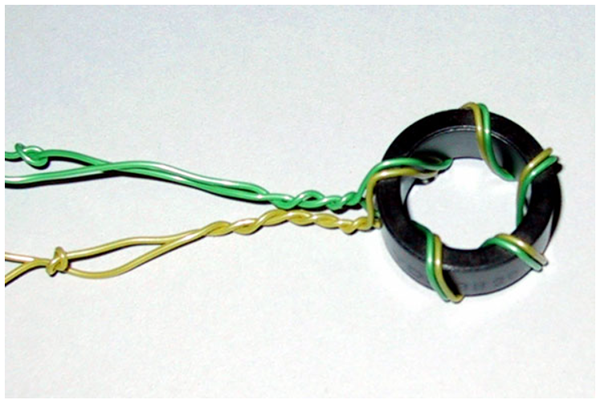
Whenever possible, the coil should be wound at equal intervals on the sample to ensure that the magnetic field (strength) in the core is uniform and that the magnetic flux density detection site is not skewed. In particular, the detection coil should be wound so as to adhere to the sample to prevent the invalid magnetic flux from interlinking in the void between the detection coil and the core. If the excitation coil and the detection coil overlap, the detection coil should be wound first and attached to the sample. If the number of windings of the excitation coil and the detection coil is the same, bifilar winding is recommended. With bifilar winding, the primary winding (excitation coil) and secondary winding (detection coil) are paired, which can reduce the leakage magnetic flux and improve the coupling coefficient between the primary and secondary windings compared to winding separately.
[Reference] Bifilar winding - What range of magnetic flux densities can be measured with the B-H analyzer?
-
A. In the region where the B-H curve is unsaturated due to sine wave excitation, the relationship between the maximum magnetic flux density Bm and the induced voltage V2 is expressed by the following equation.
f: Measurement frequency Ae: Effective cross-sectional area of the sample N2: Number of secondary windings
V2=2πfN2AeBm
Therefore, in the unsaturated region, it is possible to measure up to Bm corresponding to V2 within the detected voltage range of the B-H analyzer used. For SY-8218 and SY-8219, the maximum permissible value of V2 is 200V. Note that this equation does not apply to non-sinusoidal excitation or saturated regions.
When calculating the value of the induced voltage V2 by determining the value of the target maximum magnetic flux density Bm first, note that the peak value of the actual induced voltage V2 will be 3 to 10 times the above calculated value depending on the saturation state. In order to prevent the destruction of the sample or equipment, you should start the initial measurement at 50-75% of the target maximum magnetic flux density Bm and gradually increase the excitation level.
- What magnetic field (strength) can be excited by the B-H analyzer?
-
The maximum magnetic field (strength) Hm that can be excited is determined by the following equation.
I: Excitation current N1: Number of primary windings Le: RMS magnetic path length
The excitation current I depends on the power amplifier used.
- Can I measure not only the iron loss of the material, but also the loss including the copper loss of the coil winding?
-
If you measure using the single winding method without the detection coil on the secondary side, the loss including the copper loss of the primary side excitation coil winding can be measured. The B-H analyzer can also perform single winding method measurements.
- What should I be aware of when measuring with the thermostatic chamber scanner system SY-320A/321A?
-
When measuring samples with low magnetic permeability and low iron loss, such as pressed powder, it is recommended that the sample be placed at least 15mm away from the attached turntable SY-510/511 on which the sample is placed. The base material of SY-510/511 is aluminum. If a leakage magnetic flux is generated from the sample, and it interlinks to the SY-510/511, an eddy current loss will occur there, resulting in an error in the measurement of the iron loss and correct measurement will not be possible.
If the sample is a conductor, it is recommended to further separate the sample by at least 15mm. Likewise, if a leakage magnetic flux is generated from the sample and it interlinks to an adjacent sample, an eddy current loss will occur and correct measurement will not be possible.
- What should I pay attention to when measuring with the small single-plate magnetic measuring device SY-956?
-
One caution is not to create a gap between the measurement yoke and the sample. If there is a gap, a leakage magnetic flux will be generated, and correct measurement will not be possible. Before the measurement, always check to make sure that there is no foreign material on the sample or the measurement yoke.
The second is to minimize the void between the B coil, which is the detection coil, and the sample. If unwanted magnetic fluxes such as geomagnetism and leakage magnetic flux interlink in the air gap, correct measurement will not be possible. Particular care should be taken when measuring samples with low magnetic permeability.
- What is the inductance L of the sample that can be measured by DC superposition on the DC bias tester SY-960?
-
The upper limit of the inductance L of the sample that can be measured with SY-960 is several tens of μH. If you measure a sample with more inductance L, some of the AC supplied by the power amplifier will flow into the DC bias source SY-961 instead of the sample, and correct measurement will not be possible.
- Each time I measure, the measured value such as core loss changes greatly. What could be the cause of this?
-
In general, soft magnetic bodies have temperature characteristics. In particular, the magnetic properties of ferrite are unstable near room temperature. When making accurate magnetic property measurements of soft magnetic materials, it is necessary to take the measurements while holding the sample at a constant temperature in a thermostatic chamber.
In addition, depending on the material, the magnetic properties may change depending on the excitation time and excitation history independent of the sample temperature. By adding the optional continuous measurement function SY-811, you can observe a change over time of up to 99,999 minutes (about 70 days) of magnetic properties every 1 [min]. If the magnetic characteristics change greatly with each measurement, it is recommended to take continuous measurements with SY-811 to check whether the magnetic characteristics change over time due to the excitation time.
- The measurement results of magnetic properties vary depending on the shape of the core, even though they are the same material. What could be the cause of this?
-
This is because the magnetic flux density distribution inside the core changes depending on the shape. Magnetic flux passes through areas with low magnetic resistance inside the core. Therefore, the magnetic flux density distribution may be uneven, and places with high magnetic flux density may occur locally, showing different behavior compared to when the magnetic flux density distribution is uniformly shaped.